


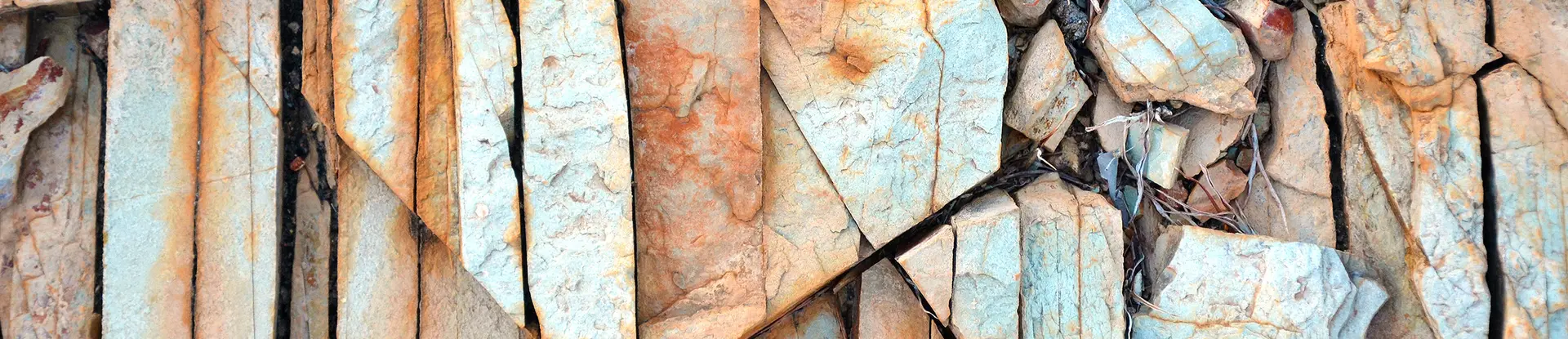
How do geological processes impact modern life? You can think of faults and fractures deep within the Earth’s crust as the planet’s “plumbing system,” carrying fluids, minerals, gas and oil to our cities and communities. Even rechargeable technology relies on access to these valuable natural resources. In recognition of Earth Day, we’re learning about the breaks, bends and forces that shift underground rock layers, making our access to resources possible.
Listen now as SwRI Structural Geologist Dr. Adam Cawood discusses faults and fractures, how Earth’s “plumbing system” works and why a diamond mine discovery in the late 1800s inspired his career path.
Visit Structural Geology & Geomechanics to learn more about SwRI geological services for oil and gas exploration, mining, construction, civil engineering and more.
Transcript
Below is a transcript of the episode, modified for clarity.
Lisa Peña: Every April, Earth Day reminds us to learn about and protect our planet. Today, we're examining how geological processes impact our lives and resources. Where you live, your access to water, even the electronics that power your life are all impacted by processes deep in the Earth. We're discussing how faults and fractures support humanity and provide resources. Plus, the hunt for a metal in high demand. That's next on this Earth Day episode of Technology Today.
[MUSIC PLAYING]
We live with technology, science, engineering, and the results of innovative research every day. Now, let's understand it better. You're listening to the Technology Today Podcast presented by Southwest Research Institute. From deep sea to deep space, we develop solutions to benefit humankind. Transcript and photos for this episode and all episodes are available at podcast.swri.org. Share the podcast and hit that subscribe button on your favorite podcast platform.
Hello, and welcome to Technology Today. I'm Lisa Peña. How do geological processes impact our cities, communities, and homes? The processes that form faults, fractures, and influence fluid flow in the Earth's crust also influence our modern way of life. Our guest today is SwRI Structural Geologist Dr. Adam Cawood. He's here to connect the dots for us and help us understand how geological processes control our access to resources. We'll also talk about the hunt for high-demand lithium used in electronics and technology. This Earth-centered conversation is great timing for Earth Day and Geologists Day, celebrated in April. So happy Earth Day and Geologists Day, and thank you for being here, Adam.
Image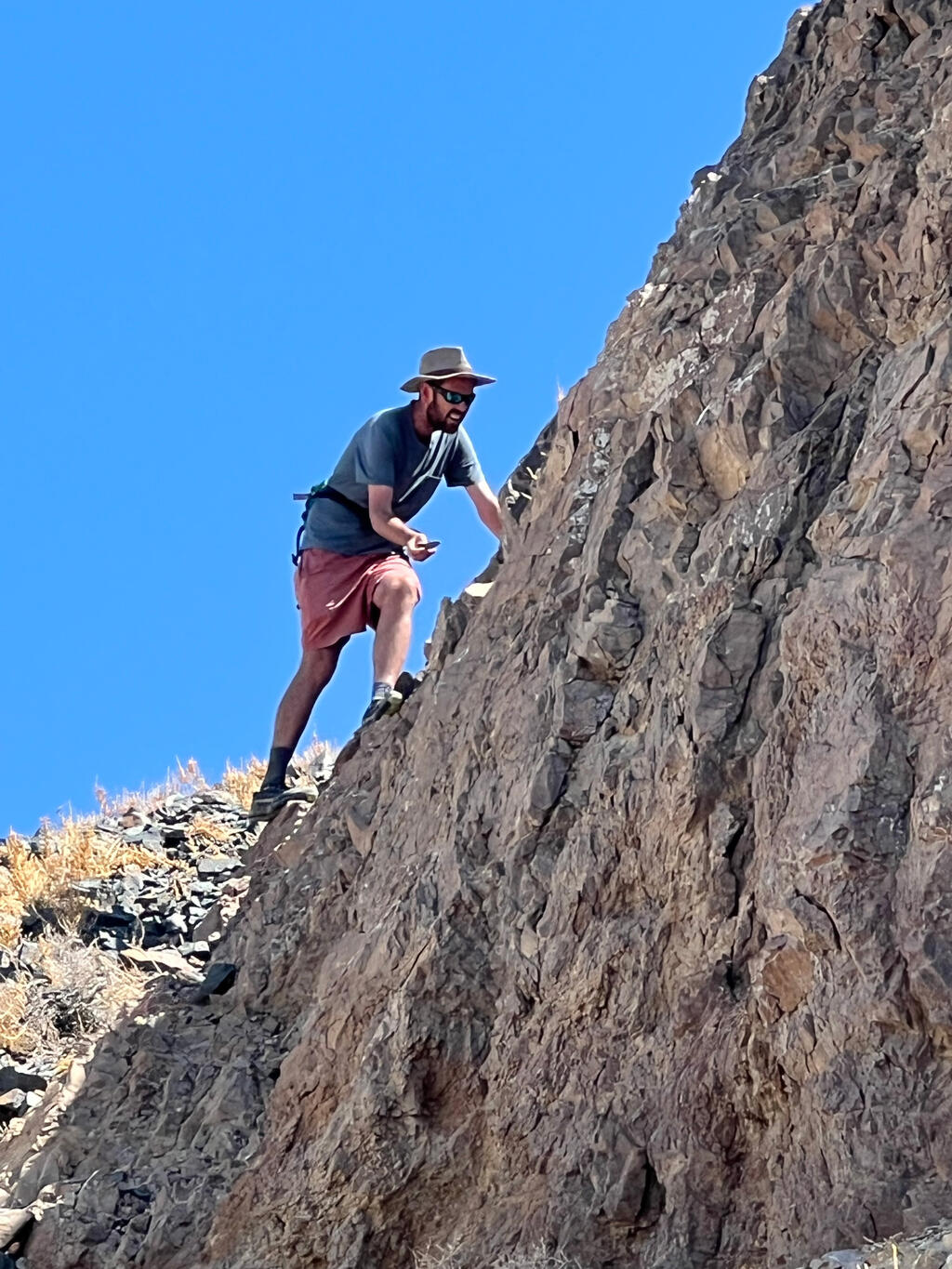
SwRI Structural Geologist Dr. Adam Cawood explores rock formations in Clayton Valley, Nevada, where the only active, producing lithium mine in the United States is located.
Adam Cawood (AC): Thank you for having me. It's a pleasure to be here.
LP: So a lot to celebrate in April and a lot to explore today as we understand how our cities, our technology all connect to geological processes. I'm excited to hear your explanation and for our listeners to understand that process. But I want to begin with your story, your inspiration to become a geologist. What sparked your interest in this field?
AC: So I actually grew up in a small town called Kimberley in South Africa, which is really famous for diamonds and diamond mining. In the late 1860s, someone picked up a small diamond. A young man picked up a small diamond on a low hill out in the middle of the desert in South Africa, and it turned out that was one of the most important discoveries of diamonds in South Africa.
About 10 years later, there was a massive diamond rush in the town. And the Kimberley Diamond Mine, or the Big Hole as it's actually called, turned out to be one of the richest diamond deposits ever found.
So I grew up in a city that basically exists because of diamonds, and because of geology, and because of the resources under our feet. And as a kid, that was always really fascinating to me. We were surrounded by geologists as kids. We always grew up with this folklore in Kimberley about the diamond mines and about this discovery by this young man of this diamond on this low hill.
And it just really fascinated me how society and the people around us could all be influenced by the resources under our feet. And that's the curiosity that really pulled me into geology in the first place. I wanted to understand how these resources form and why they occur where they do.
LP: All right. That's fascinating. You grew up surrounded by it. So intrigued that this is what you wanted to do with your life. So you are specifically a structural geologist studying faults and fractures and how they influence fluid flow in the Earth's crust. So let's define these terms. In geology, what is a fault? What is a fracture? And what is the difference?
AC: Yeah. So as you say, I'm a structural geologist. Faults and fractures are really what I focus on. And these are essentially cracks and breaks in the Earth's crust. And they control where water flows, where oil and gas accumulates, and where minerals, such as lithium, form.
And so while diamonds were the hook that got me interested in geology, these structures, I think, are some of the most fundamental and most important things beneath our feet. And they really are the plumbing systems of the Earth's crust.
So in terms of definitions, a fracture is just a break in the Earth's crust where the rock is broken, and a fault is where a fracture occurs and there's been movement of rock across that fracture, OK? So that's really the simplest definition we have for faults and fractures.
LP: So us nongeologists aren't normally thinking about what's happening in the Earth's crust, and we certainly don't think, oh, this affects my day-to-day life. But that could not be farther from the truth. So historically, fault zones have attracted settlers. So let's talk a little bit more about that. Why is that?
AC: So most rock beneath our feet is quite impermeable and quite tight, so fluid can't flow through this rock very easily. And faults and fractures allow that fluid to flow through these pathways beneath ground.
And so these systems and these features beneath our feet are important for, for example, oil and gas, as I mentioned earlier, and for any minerals that might accumulate. But also in this part of the world, they're really important for water resources. So the Edwards Aquifer, which we in San Antonio rely on for our drinking water, much of the permeability or fluid flow through the Edwards Aquifer is provided by faults and fractures.
And we have this fault system in South Central Texas called the Balcones Fault Zone, which runs northeast along I-35. So San Antonio and Austin and heading up towards Dallas. And historically, there's been a lot of settlement in these areas, because these are the places &mdash because of the Balcones Fault Zone, we've got these natural springs.
So San Solomon Springs, Comal Springs, San Marcos Springs, San Pedro Springs, all these really important sources of fresh drinking water in this pretty arid environment where even from pre-historical times, Native peoples have been living in these places, relying on that water source. So really important for our society here.
LP: We're not here by accident. Those faults and fractures brought us here.
AC: Right. Absolutely. I mean, without the fault and without the drinking water, there just wouldn't be these population centers in this area.
LP: OK, so what are some resources, you've mentioned oil and gas, and we're going to talk about lithium a little bit later. But what are some resources besides water found around fault zones?
AC: So as I mentioned, faults and faults and fractures are very important for fluid flow. And it turns out that fluids and water particularly tends to carry many of the most important minerals that we rely on. So for example, copper and gold and silver, they all get transported by hydrothermal fluids. So hot water essentially that picks up these elements from deeper in the Earth's crust and transports them along faults and fractures. And then later as that water cools, it redeposits those minerals.
So in terms of traditional mineral systems like metals and economic geology, really important for those things. And we've known about that since at least the 1700s, really. In Europe and in other places, people understood that faults and fractures were really important conduits for fluid flow and associated mineralization. As I mentioned, oil and gas, really important in the oil and gas world. And again, we've known about this for a very long time, migration of oil and gas along faults and fractures.
Increasingly, we're worrying about and thinking about faults and fractures in terms of modern renewable energy systems. So as you said, we'll talk about lithium in a minute. But things like geothermal energy are highly reliant on fault and fracture permeability.
There's a lot of activity in the Western US in places like Nevada and Eastern California where we're trying to essentially extract heat from the Earth. And getting that heat out of the Earth's crust can actually be quite technically challenging because we drill these wells. And if you drill a well that's very deep and you start pumping water into it and trying to produce that thermal energy, you really need those transport corridors to help make that heat transfer more efficient in the Earth's crust. So that's a really important component.
And then as we start thinking about trying to sequester or store materials in the Earth's subsurface, so things like carbon dioxide, things like radioactive waste materials, even short to medium-term storage of things like hydrogen and helium in the Earth's crust. We then need to start worrying about potential detrimental effects of faults and fractures, and how they can negatively impact these reservoirs and these places where we're trying to put fluids in the subsurface. So if I'm pumping some million barrels of oil or gas or CO2 beneath the Earth's crust, if we have faults and fractures there that we don't understand the permeability structure of those, that can be a real problem for us.
LP: Because then the stuff we don't want to be exposed to can be carried through water sources, so we need to know where those faults and fractures are.
Image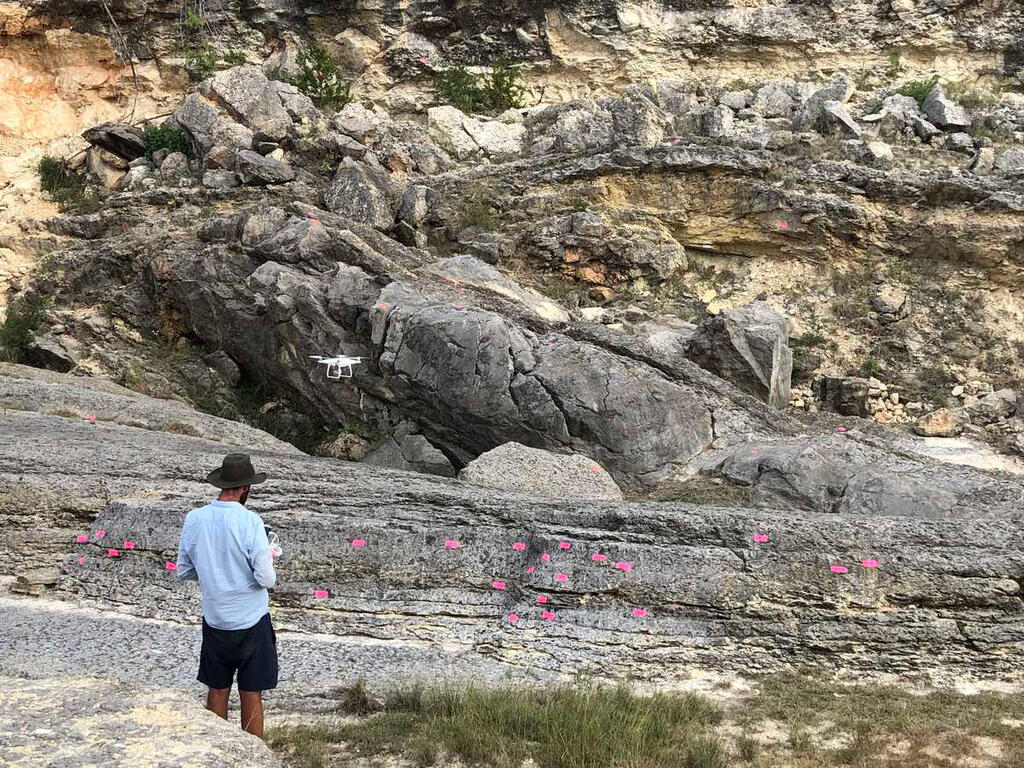
Cawood conducts field studies using a drone to collect aerial images of surface rock exposures, or outcrops. The images allow geologists to create high-resolution 3D reconstructions of the formations and extract geological information.
AC: Yeah. So for waste materials, we really don't want to be much of what we do in the subsurface is about responsible stewardship and careful management of subsurface resources. And that includes the bad stuff that we're putting down there and injecting down there. We don't want to be contaminating our aquifers. We don't want to be causing earthquakes. We want to make sure that if there are faults or fractures in those places, we really understand them, and we're not going to be doing something that's going to ultimately be detrimental to us.
LP: All right. So that brings us to one of the current in-demand resources coming straight from the Earth, lithium. So tell us more about lithium. What is it? Why is it in such high demand?
AC: So lithium is a very light metal that's become extremely important for modern technology. And it's a key component, really, in rechargeable batteries, the kind of rechargeable batteries that are used in iPhones, laptops, electric vehicles. And lithium has become so important because it can store a lot of energy relative to its weight, which is why it's widely used in portable electronics and electric transportation.
And as the world tries to move away from oil and gas, for example, and towards renewable energy and electrification, we really need to use more lithium. And there's an increasing demand for lithium in these sort of rechargeable battery systems.
LP: So with that widespread use of this technology comes the widespread demand for lithium. So where is it abundant?
AC: So it turns out that lithium is actually relatively abundant everywhere, and that's kind of surprising. So in seawater, if I'm remembering my figures correctly, it's about 20 parts per million globally. Which doesn't sound like a lot, but in terms of elements, that's relatively abundant. In the Earth's crust, generally across the world, we're talking about lithium concentrations of 25 to 30 parts per million.
But for a lithium resource to be economically viable, we really need thousands of parts per million. So 2,000 to 5,000 to 7,000 parts per million. And the reason we need those abundances is that because if we're going to be mining that material and refining it and extracting the lithium out of those materials, we need to have high enough abundances that it can be economically viable and we can actually make the economics of that system work.
So lithium is abundant in a number of places in economic levels around the world. A really well-known example is what's called the Lithium Triangle in South America, which includes parts of Chile, Argentina, and Bolivia.
And those regions are very, very dry, arid environments, and they have these large salt flat basins high up in the Andes where lithium-rich brines accumulate. And much of the lithium enrichment in the Lithium Triangle is related to evaporation of these surface brines that basically through, over geologic time scales, tens of thousands or millions of years, they concentrate that lithium within those brines until they get to high enough concentrations that they become economically viable.
There are large economic lithium deposits in Australia and China and Zimbabwe, actually, interestingly. Those are a different lithium deposit type, which we're not really going to be talking about today.
And in the US currently, we're still, the community, the geology community is still looking around and trying to get a better understanding of lithium accumulation in the US. But the Western US, Nevada and Eastern California, are well-known places for lithium accumulations. Clayton Valley and Thacker Pass.
And actually, recently, we're starting to produce lithium from oil field brines in East Texas. So these are places where people for decades have been drilling oil and gas wells. And when you produce oil and gas, generally you produce a certain amount of water at the same time. And that water normally needs to be cleaned up and reinjected or disposed of in a responsible manner.
What's been found is that those waters are actually enriched in lithium. So what oil and gas producers are doing currently is producing the oil and gas. The associated water, they're stripping the lithium out, cleaning that water up, and re-injecting it. So it's a two-for-one really they get from that system, which is kind of amazing.
LP: OK. So it sounds like, as you said, the geological community is well aware of these lithium hotspots, but it is a high-in-demand metal. So it sounds like we need more. So how do we find more? What is your process for figuring out where the next hotspot is located?
AC: Yeah. So that's a tricky one. Much of what we do as geologists is about exactly that, right? Finding where these resources are and how to get better at exploring for these resources.
And much of it, I think, comes down to a more robust and thorough scientific understanding of these systems. Much of what we know, for example, in the oil and gas world, for exploring for oil and gas, comes down to fundamental good science and really understanding these systems from the ground up, understanding how the oil forms, how it accumulates, how it migrates, and how best we can produce that oil and gas.
And lithium systems are really analogous to in that we need to understand what we in geology call the source to sink environment. So where are the ultimate sources? Where does this lithium come from in the very beginning? What are the geologic processes that help the formation of these lithium sources? How does the lithium get transported from these source areas into where it is present day? And how does it get accumulated over geologic time scales?
And like I say, much of that is based on fundamental understanding of geologic processes. So some actually very detailed scientific analysis, collecting lots of data in the field, doing laboratory analyses, doing a bunch of numerical modeling to figure out how these processes work.
And then in terms of mineral exploration companies, so going out and actually finding lithium, you've got a lot of different techniques available to you. You can go out and you can sample the ground and sample groundwaters, and do tests and run models to see where you think the highest concentrations of lithium might be.
And then ultimately developing exploration workflows that are, I guess, more mature and more robust where you start looking at a system and you use certain classifications, and you say, OK. Well, we know these four or five or 10 fundamental things about these lithium systems. And formalizing that into a framework which you can start using to apply a more robust exploration approach.
And in oil and gas, for example, oil and gas exploration has been around for well over 100 years, so that is quite a formal framework that we have in place. We know how to do it. People still drill dry holes. We don't always have exploration success. But lithium exploration is relatively new. It's only been around for a decade or two, really. So it's about coming up with more robust exploration approaches.
LP: You have spent some time in internal research and development projects looking for these lithium deposits. So tell us about your project in Nevada.
Image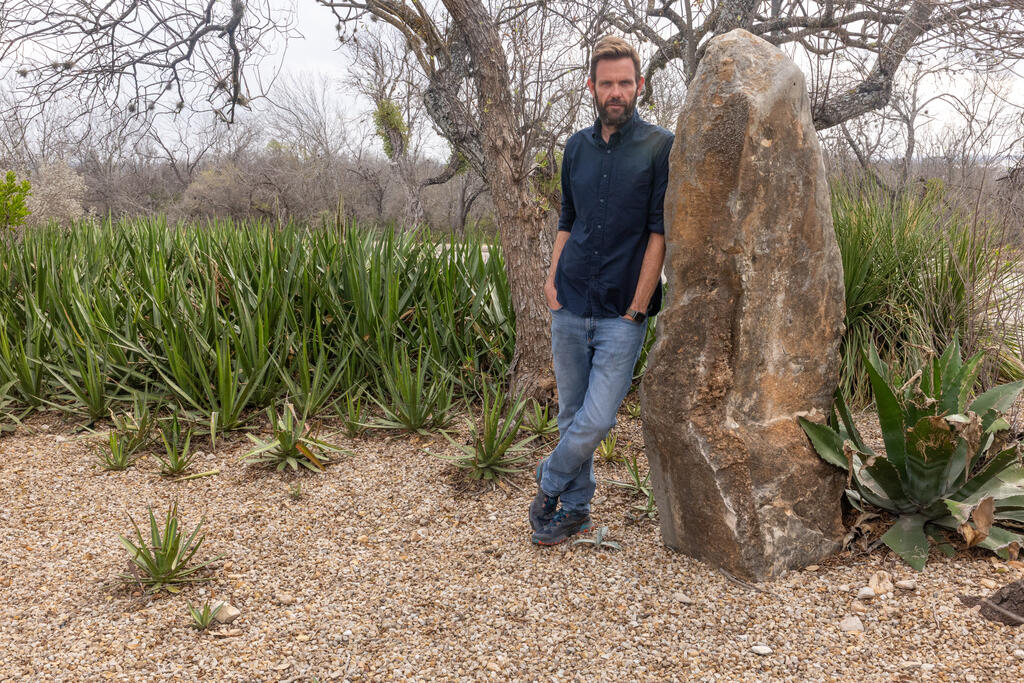
Growing up in Kimberley in the North Cape province of South Africa where a diamond mine produced 14.5 million carats of diamonds from 1871-1914, Cawood was surrounded by geologists in his community. They inspired him to pursue a career in the field. Cawood is currently conducting research to discover new domestic sources of lithium widely used in rechargeable batteries.
AC: Yes. So as you say, we've run now two internal research and development projects here at Southwest Research Institute. And these were both focused on a place called Clayton Valley in Nevada. So I'm going to give you a little bit of history about Clayton, Nevada, and then I'll tell you about the internal research project.
But lithium was first discovered in Clayton Valley, I think, in the 1950s. And it was discovered purely by accident. Someone was sampling a hot spring, doing a geochemical analysis of a hot spring out in the middle of the desert on the basin floor, and they found that these springs were enriched in lithium. 10 years later, there was a full-on lithium mine operating in this valley, and it's been operating ever since. It's the largest producing accumulation of lithium in the Western US.
So Clayton Valley's an interesting place in that the lithium we're not doing mining in Clayton Valley in the traditional sense. We're not digging up huge volumes of rock and crushing it up and breaking it and putting it through a processing mill.
Simply what happens in Clayton Valley is they drill water wells. They produce these waters or lithium brines that are highly enriched in lithium, and they pump them into these evaporation ponds at the Earth's surface and let nature do the rest, right? So we're in these very arid environments, and they just pump these brines into these ponds, and they let evaporation do its work and to concentrate the brines over time.
It's a fascinating place. And if you drive out to Clayton Valley in the middle of the desert, middle of nowhere, you suddenly come over this hill, and there are all these what look like massive swimming pools in the distance. And that's what Clayton Valley looks like.
So we got involved in Clayton Valley through a collaboration between Southwest Research Institute and the University of Texas at Dallas. We have some collaborators at UT Dallas who are experts in the world of lithium. But they were really looking for a group or some people with some structural geology and tectonics expertise, so it was a really good, natural fit between us.
It turns out that tectonics and structural geology are really important for lithium systems generally, and that's particularly true in the basin and range where you really need fault systems to be able to transport lithium and to help it accumulate over geologic time scales. So we've been working with these folks at UT Dallas for a couple of years now, working with their PhD students and with faculty members there, writing proposals from the National Science Foundation and for the Department of Energy, writing papers and presentations and all that kind of stuff.
And what we found at Clayton Valley is that the entire basin is shaped by faults, and those faults created the basin. That basin and that valley wouldn't be there without the faults. And these faults allowed fluids to circulate through the rocks and helped concentrate lithium in groundwater over millions of years.
So those evaporation ponds that I was talking about, those really are the end result of long geologic processes over tens or dozens of millions of years, that over time concentrated and transported the lithium into the basin and allowed it to accumulate in that place. It's kind of a fascinating place.
LP: Have you found any other promising areas for lithium production in the US? I know you mentioned East Texas. Are there others?
AC: So Nevada is definitely the most active region right now. There are places in Southern California where people are actively looking for lithium too. There's a place that's quite similar to Clayton Valley called the Salton Sea in Southern California. And this is a place which is one of these very arid basin and range valleys. You drive through there and it reminds you of Death Valley. It's extremely arid, high mountains all around it.
And that's a place where actually people are trying to combine geothermal energy production with lithium production. So I mentioned combining oil and gas production with lithium in East Texas. In the Salton Sea, what they're trying to do is to drill geothermal wells and produce hot water that they use to drive turbines at the Earth's surface.
As it turns out, in this place, the geothermal waters are also enriched with lithium. So the plan here is to produce the hot water, drive turbines. At the same time, pull the lithium out of the water through chemical processing, and then re-inject it as cooler rinds. And then produce it again and again and pull out the lithium. It's kind of a fantastic system.
In the US, I think the Western US or Nevada and Eastern California are currently the most prospective. And mainly, that's because they have the right general geologic conditions. And there are a couple of things that you really need for lithium, and the first one is you need volcanic rocks, because that's the ultimate source. So you need what we call rhyolites, which are these quite light-colored volcanic rocks. They're not too different from granites in some ways. Where you have big ash flow deposits from erupting volcanoes, those are really important lithium sources too.
So that's one of those when I talked about understanding lithium systems and being better about exploring for lithium, volcanic rocks and rhyolites and ash flows are really important. They're a primary source, and they have to be in place to be able to make lithium systems work. So that's really why the Western US is so important for these lithium systems.
LP: So I have heard of volcanic deposits in South Texas. What are the chances there's lithium deposits there too?
AC: Right. So there are volcanic features in South Texas. So there's Uvalde, for example, there's a big volcanic field in Uvalde. And basically, if you look at the right geologic data in the subsurface, you can actually see that there are hundreds of these little volcanoes that are now buried. They were active during the Cretaceous, so about 100 million years ago.
As it turns out, lithium enrichment is really closely related to the type of volcano and the type of magma that's formed. It's quite a complicated process, but the rhyolites and ashes and ash flow tuffs that are present in Nevada are mostly the result of melted crust. So if you have the Earth's crust, which can be 30 or 40 kilometers thick, the base of that crust can get really, really hot, and it can actually start to melt under the right conditions.
If the base of the Earth's crust melts enough, that can actually be forced up as volcanic features right up through 30 kilometers of Earth's crust and be erupted at the Earth's surface as rhyolitic magmas. So those types of rhyolites and ashes that we talked about, those are really the result of melting of the Earth's crust.
Unfortunately, most of the volcanics in South Texas and Uvalde, they come from a different magma source, not from melting of the Earth's crust, so they are less likely to be enriched in lithium. Having said that, there are plenty of places where we still need to look, and I wouldn't be surprised if we find many more lithium accumulations in the US.
LP: So the type of volcanic rock matters.
AC: Absolutely, yeah.
LP: Interesting.
AC: And so the type of volcanic rock and how those volcanic rocks formed are fundamentally important for the geochemistry of those rocks. So if you break a piece of that volcanic rock up and take it to a lab and do an analysis on it, you'll see that volcanic rocks vary substantially, depending on how they were formed and what the initial source material was for those volcanic rocks.
So did this lava that formed at the Earth's surface, did that form from melting of the Earth's crust at depth, or did it form because it came up very deep from the Earth's mantle, for example? Did it come from a mid-ocean ridge in places like Iceland? And all of those volcanic rock types have very different geochemical signatures, and that feeds directly into the types of minerals, such as lithium, that you might find associated with those rocks.
LP: Really intriguing. Geochemical signatures matter.
AC: Absolutely.
LP: All right. Great to know. OK. So your work takes you all over the world. It certainly sounds adventurous. Do you have a favorite career memory or discovery?
AC: I always find that kind of a tough question, because I don't know. We're always out discovering stuff and looking at new outcrops and new places. And I just love it all.
LP: All of it's fascinating.
AC: Yeah, really. And so I love the work out in West Texas and in the desert, in Arizona and Nevada and those sorts of places. Having grown up in Kimberley in South Africa, which is a very dry, arid place too, the desert has always been home to me.
And you know, often when we're out in the field, we often can spend up to a week at a single relatively small outcrop. So taking very detailed measurements of fault sizes and orientations and collecting samples for geochemical analysis, for example. Or taking very small pieces of calcite, very carefully sampling them out of faults to be able to do dating, to try and understand the age of those faults and fractures. And that's all fascinating, very detailed work.
But my favorite thing when we're doing that sort of work is going off, exploring, and looking for new outcrops out in the desert. I always have this thing when I'm out doing field work. Like, has anyone actually ever seen this outcrop, or am the first person to ever, and it's kind of a different sort of exploration. It's sort of scientific exploration. We're not looking for as much of the work that we do is relatively academic. We publish on this stuff. We write papers to understand these fundamental systems in more detail.
But yeah, the exploration that I like to do is for amazing new outcrops that can tell us more about geology and help with our fundamental understanding. It's not about finding resources per se, for me.
LP: On a much smaller scale, my son found a rock in our backyard with the imprint of a shell.
AC: Oh, cool.
LP: And we were intrigued by that just because so I started Googling, and then understood that we'd been underwater, I don't know how, you probably know how long ago that was in the San Antonio area. And then I had the same thought. Like, how did we come upon this rock that's probably been in existence, probably had the shell imprinted who knows millions of years ago.
AC: Yeah, right. That shell was probably 100 million years old. The formation that that came from might have been Austin chalk, for example. That's pretty common around here. Outcrops of Austin chalk or the anacacho limestone.
And these were all rocks that were this part of the US was an ocean, essentially, like an interior sea for tens of millions of years in the Cretaceous. So around 90 to 100 million years ago, this was a shallow, open water ocean. We had reefs. We had these sort of marine environments. And yeah, the rocks around here have got just full of fossils. It's amazing.
LP: The rocks tell stories.
AC: Yeah.
LP: For sure. OK. So SwRI conducts widespread research studying faults and fractures. Why is this type of research so important? You've already touched on it quite a bit, but it expands beyond your research. It's sort of a institute-wide research topic.
AC: It's really important to understand these plumbing systems because they are so ubiquitous. And much of the work here at SwRI traditionally and I'm talking about over the past decades before my time, really was focused on Yucca mountain and storage of radioactive waste in the subsurface. And this was a project in Nevada not too far away from Las Vegas where the plan was to situate a long-term repository for radioactive waste.
And as part of that study, they needed to understand what the likelihood was, that if they could store radioactive waste down there, what was the chance that there would be fluid flow along faults and fractures? And how that might contaminate the groundwater, for example, in the subsurface.
So we've talked a lot today about faults and fractures being important for fluid flow. But the other big thing is earthquakes. I mean, earthquakes occur along faults. That's the place that they occur, only along faults and nowhere else.
So if you want to understand seismic hazard or the potential for an earthquake, you need to understand fault systems at a particular site. You need to understand the structure of those faults, how they behave, what their geometries are. And all of that feeds into the likelihood that there might be an earthquake along any given fault over time.
And we have groups at SwRI who have worked on earthquake hazard for decades and continue to work on that aspect of fault systems. So for example, if you're planning to build a nuclear power reactor or a power station, or if you're planning to put a hospital somewhere, or if you're planning to put anything that's really important, you really need to worry about earthquakes, and you really need to work hard to figure out or estimate what the chance of an earthquake occurring in the next 100 years, 1,000 years, 10,000 years is. And a lot of the work that we've done at SwRI over the years has been focused on understanding the probability of earthquake occurrence over time.
LP: All right. And what motivates you in your work in structural geology? What do you love about this field? You've mentioned you do love it. It's fascinating. But what is it about the field that draws you in?
AC: So I just naturally fell in love with structural geology during my undergrad degree in the UK. I just found it really fascinating. I think what I really find satisfying about it is that it's very physics-based. It's very it connects a lot of different areas. So on one hand, it's very practical. It helps us to understand resources and hazards and how we interact with the subsurface, things like energy production, groundwater systems, and underground storage. But I'm just really fascinated by the processes themselves.
You know, structural geology's all about deformation. So how rocks break and bend and move under stress, and how tectonic plates and tectonic forces break and push around and move rocks. And I just find that, I don't know quite dramatic and kind of exciting, really. There's lots of mechanics and physics, which I find really interesting.
And one of the most fascinating things, at least for me, is that deformation and structural geology and tectonics and those processes occur at all geologic scales, right? So they occur from the scale of our global tectonic plates right down to individual mineral grains in a tiny little sample, sliding past each other inside of a rock.
And it's not just about Earth. We see faults and fractures and deformation processes on Mars and the moon and many other planetary bodies. So it's one of those areas of geology that connects planetary sciences, physics, engineering, and many real-world applications. So I just find it fascinating, really.
LP: Yeah, completely. So fascinating. OK. As we mentioned, April marks Earth Day. The 2026 theme is Our Power, Our Planet, emphasizing individual and community action to advance environmental progress. So what is your advice to use our power for the good of our planet?
AC: So I would just say, be mindful of using resources. As a geologist, I'm well aware that none of our resources are infinite. So whether it's lithium or whether it's water or whether it's oil and gas, all of these are finite resources. And extracting them and using them has some environmental impact ultimately, regardless of what you're using. So if possible, try to reduce consumption. Try to use resources more responsibly. Because ultimately, that'll be better for our planet in the long run.
LP: OK. Excellent advice as we mark Earth Day this month. Adam, thank you for joining us and helping us understand the Earth's plumbing system, as you called it, and answering that important question for us today. What do processes in the Earth have to do with me? As it turns out, quite a bit. So such an intriguing connection between geology and modern life.
AC: Thanks for having me.
And thank you to our listeners for learning along with us today. You can hear all of our Technology Today episodes, and see photos, and complete transcripts at podcast.swri.org. Remember to share our podcast and subscribe on your favorite podcast platform.
Want to see what else we're up to? Connect with Southwest Research Institute on Facebook, Instagram, X, LinkedIn, and YouTube. Check out the Technology Today Magazine at technologytoday.swri.org. And now is a great time to become an SwRI problem solver. Visit our career page at SwRI.jobs.
Ian McKinney and Bryan Ortiz are the podcast audio engineers and editors. I am producer and host, Lisa Peña.
Thanks for listening.
[MUSIC PLAYING]
SwRI’s structural geology and geomechanics services analyze the complex interplay between mechanical stratigraphy, natural deformation and subsurface stress conditions. Our research, consulting and training services are beneficial for oil and gas exploration, mining, construction and civil engineering applications.
How to Listen
Listen on Apple Podcasts, or via the SoundCloud media player above.